ch13.interface_protocols_abc
Ch13. Interfaces, Protocols, and ABCs
graph LR;

A["Four Approaches to Typing"]

A --> AA["Duck Typing\ntraditional python\ntype defined by what method it provides\ninterface isn't enforced"]
A --> AB["Goose Typing\nPython 2.6 through ABC\nEnforce runtime check\nEnsure object conforms to an expected interface"]
A --> AC["Static Typing\nPython 3.5\ntyping module"]
A --> AD["Static Duck Typing\nPython 3.8\ntyping.Protocol"]
graph LR;
B["Protocol in Python's context?"] --> BA["Object Protocol\nA set of methods that\nan object must provide \nto fulfill a role"]
C["Protocol Type"]

C --> CA["Dynamic Protocols\ninformal, implicit interfaces\ndefined by convention and\ndescribed in documentation."]
C --> CB["Static Protocols\ndefined explicitly\nusing typing.Protocol subclasses."]
graph LR;
D["Monkey Patching\nDynamically modifying\na module, class, or function \nat runtime to add features or fix bugs\nwithout altering the original source code."]


E["EAFP\nEasier to Ask Forgiveness\nthan Permission"] --> EA["attempt the operation directly\nhandling any exceptions that arise."]
graph LR;
F["Virtual Subclasses\nusing the register method on the ABC"] --> FA["No inheritance needed"]
F --> FB["Pass issubclass and\nisinstance checks"]
F --> FC["Often used to register built-in or\nexternal classes as \nvirtual subclasses of ABCs."]
graph LR;
G["Nominal Typing\nInvolves explicitly linking\na class to an ABC through\ninheritance or registration"] <--> GA["Structural Typing\nDetermines the type\nbased on its structure\nspecifically the methods and\nattributes it implements\n\nnot through\ninheritance hierarchy"]
GA --> GAA["Achieved by static protocols\nIn Python 3.8\ntyping.Protocol"]
GA --> GAB["@runtime_checkable decorator\nmade runtime checkable"]
Programming to an Interface
- Object-Oriented Programming (OOP) and Interfaces:
- The core principle of OOP is to "program to an interface, not an implementation," as emphasized by Gamma, Helm, Johnson, and Vlissides.
- In Python, understanding a type is rooted in knowing the methods it provides — its interface.
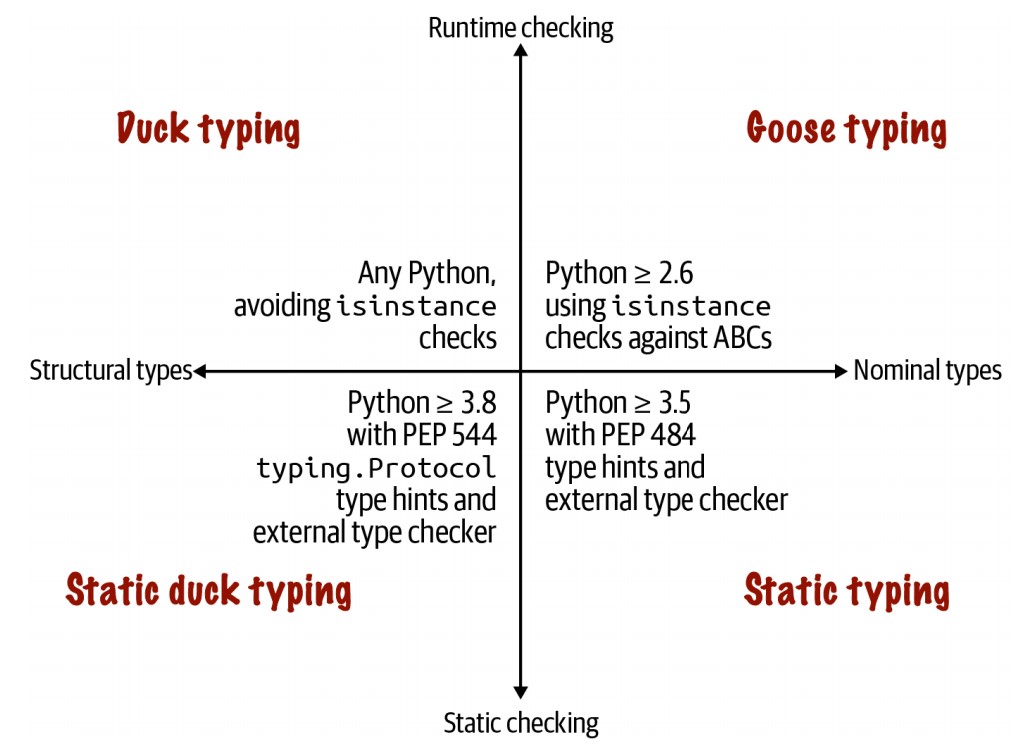
Four Approaches to Typing in Python:
- Python supports multiple ways to define and use interfaces, especially since Python 3.8:
- Duck Typing:
- The traditional Python approach where an object's suitability is determined by the methods it supports, rather than its class inheritance.
- Example: "If it looks like a duck and quacks like a duck, it's a duck."
- Goose Typing:
- Introduced in Python 2.6 through Abstract Base Classes (ABCs).
- Provides a way to enforce type checking at runtime by comparing objects against ABCs.
- Focuses on ensuring that an object conforms to an expected interface.
- Static Typing:
- Traditional typing method seen in languages like C and Java, now supported in Python via the
typingmodule (since Python 3.5). - Relies on external tools like MyPy to enforce type hints and ensure code correctness before runtime.
- Traditional typing method seen in languages like C and Java, now supported in Python via the
- Static Duck Typing:
- Inspired by Go, this approach uses subclasses of
typing.Protocol(introduced in Python 3.8) to define interfaces that can be checked statically. - Combines the flexibility of duck typing with the rigor of static type checking.
- Inspired by Go, this approach uses subclasses of
Two Kinds of Protocols in Python
-
Understanding Protocols:
- The term "protocol" in computer science varies by context.
- In Python, it refers to a set of methods that an object must provide to fulfill a role, commonly known as an "object protocol."
-
Dynamic Protocols (Informal Interfaces):
-
Definition:
- These are informal, implicit interfaces defined by convention and described in documentation.
- Python's dynamic protocols are a key part of its flexibility, allowing objects to behave in certain ways by implementing specific methods, even if only partially.
-
Example: The sequence protocol is a common example. By implementing
__getitem__, a class can behave like a sequence, allowing indexing, iteration, and theinoperator.class Vowels: def __getitem__(self, i): return 'AEIOU'[i] v = Vowels() print(v[0]) # Output: 'A' print(v[-1]) # Output: 'U' for c in v: print(c) # Iterates over 'A', 'E', 'I', 'O', 'U' print('E' in v) # Output: True print('Z' in v) # Output: False -
Partial Implementation:
- A class can implement only part of a protocol (e.g., just
__getitem__without__len__), and still function in some contexts.
- A class can implement only part of a protocol (e.g., just
-
Sequence Protocol:
- In the Python/C API, the
PySequence_Checkfunction returns1if an object has a__getitem__method (unless it's a subclass ofdict), confirming the sequence protocol's dynamic nature.
- In the Python/C API, the
-
-
Static Protocols (Explicit Interfaces):
- Definition:
- Introduced in Python 3.8 with PEP 544, static protocols are defined explicitly using
typing.Protocolsubclasses. - Static protocols enforce the implementation of all methods specified in the protocol class, ensuring full compliance.
- Introduced in Python 3.8 with PEP 544, static protocols are defined explicitly using
- Example:
- A static protocol defines a set of methods that a class must implement to satisfy static type checkers like MyPy.
- Strict Compliance:
- Unlike dynamic protocols, static protocols require every method in the protocol to be implemented, even if some methods are not used in the program.
- Static Type Checking:
- Static protocols are verified by static type checkers, providing a level of assurance not available with dynamic protocols.
- Definition:
-
Key Differences:
- Dynamic Protocols:
- Implicit and informal.
- Partial implementation is often acceptable.
- Cannot be verified by static type checkers.
- Static Protocols:
- Explicitly defined with
typing.Protocol. - Requires full implementation of all methods in the protocol.
- Can be verified by static type checkers.
- Explicitly defined with
- Dynamic Protocols:
Programming Ducks
- Python and Sequences:
- Python's data model is designed to cooperate with dynamic protocols, especially for sequence-like objects.
- The interpreter makes every effort to work with even the most basic sequence implementations.
Python Digs Sequences
-
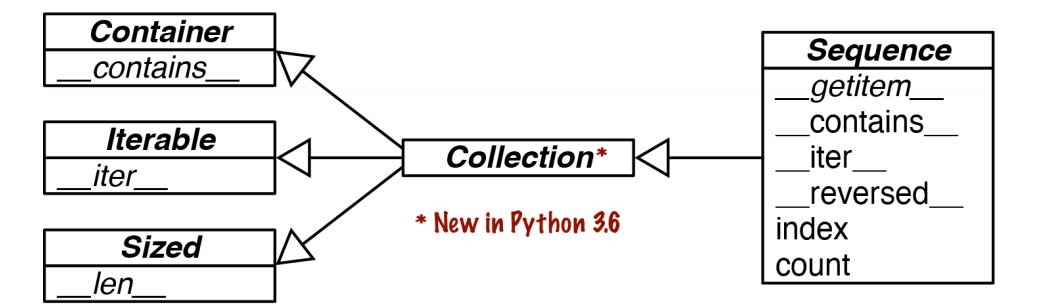
Formal Sequence Interface:
- The
Sequenceinterface is formalized as an Abstract Base Class (ABC) in thecollections.abcmodule, but Python's interpreter and built-in sequence types (e.g.,list,str) do not rely on this ABC. - The
SequenceABC is a guide to what a complete sequence type should support.
- The
-
Core Methods:
- A subclass of
Sequencemust implement:__getitem__: Allows item access by index.__len__(inherited fromSized): Allows the use oflen()on the sequence.
- Other methods in
Sequenceare concrete and can be inherited or overridden.
- A subclass of
-
Dynamic Sequence Behavior:
-
Fallback Mechanisms:
- Python makes sequence-like objects work even with minimal implementations.
- If a class has
__getitem__but lacks__iter__and__contains__, Python:- Iterates over the object by calling
__getitem__with increasing integer indices starting from 0. - Uses a sequential scan to implement the
inoperator, checking for item membership.
- Iterates over the object by calling
- Example with
Vowels:- The
Vowelsclass from the previous example only implements__getitem__, but Python still supports iteration andinoperations on it.
- The
-
Full Sequence Protocol: The
FrenchDeckclass implements both__getitem__and__len__, making it a proper sequence without subclassingabc.Sequence
import collections Card = collections.namedtuple('Card', ['rank', 'suit']) class FrenchDeck: ranks = [str(n) for n in range(2, 11)] + list('JQKA') suits = 'spades diamonds clubs hearts'.split() def __init__(self): self._cards = [Card(rank, suit) for suit in self.suits for rank in self.ranks] def __len__(self): return len(self._cards) def __getitem__(self, position): return self._cards[position] -
-
Python's Iteration Mechanism:
- Python's ability to iterate over objects without relying on the
SequenceABC demonstrates extreme duck typing. - The interpreter directly implements these behaviors in C, independent of the
SequenceABC. - Sequence ABC Methods:
- The
__iter__and__contains__methods in theSequenceABC mimic the interpreter's built-in behavior but are not relied upon by the interpreter itself.
- The
- Python's ability to iterate over objects without relying on the
Monkey Patching: Implementing a Protocol at Runtime
-
Monkey Patching: Dynamically modifying a module, class, or function at runtime to add features or fix bugs without altering the original source code.
- However, it tightly couples the patching code to the internals of the program, often involving private and undocumented attributes.
-
Use Case Example: Shuffling a
FrenchDeckInstance:- The
FrenchDeckclass is designed to behave like a sequence but lacks the ability to be shuffled using Python's built-inrandom.shuffle()function.
- The
-
Standard
random.shuffleMethod:-
Purpose: Shuffles a sequence in place.
-
Example:
from random import shuffle
l = list(range(10))
shuffle(l)
print(l)  # Output: [5, 2, 9, 7, 8, 3, 1, 4, 0, 6]  # Example shuffled list
-
-
Problem:
-
When attempting to shuffle a
FrenchDeckinstance, aTypeErroroccurs:from random import shuffle from frenchdeck import FrenchDeck deck = FrenchDeck() shuffle(deck) # Output: TypeError: 'FrenchDeck' object does not support item assignment -
Reason:
FrenchDeckimplements the immutable sequence protocol (supports__getitem__), butrandom.shufflerequires the mutable sequence protocol (which includes__setitem__).
-
-
Monkey Patching to Add
__setitem__:-
Solution: Dynamically add a
__setitem__method to theFrenchDeckclass, enabling it to support item assignment and thus be compatible withrandom.shuffle.- Define a
set_cardFunction to allow item assignment within the deck.
def set_card(deck, position, card): deck._cards[position] = card- Monkey Patch the
FrenchDeckClass: Assign theset_cardfunction to the__setitem__attribute of theFrenchDeckclass.
FrenchDeck.__setitem__ = set_card- Shuffle the Deck: With
__setitem__added,random.shufflecan now shuffle theFrenchDeckinstance.
shuffle(deck) print(deck[:5]) # Output: [Card(rank='3', suit='hearts'), Card(rank='4', suit='diamonds'), ...] - Define a
-
-
Signature of
__setitem__:- The
__setitem__method is defined with three parameters:self,key, andvalue. In theset_cardfunction, these are represented bydeck,position, andcard. - Naming the first argument
selfis conventional, but any name can be used.
- The
-
How It Works:
- The
set_cardfunction interacts with the private_cardsattribute ofFrenchDeck, which must be a mutable sequence (e.g., a list). This allows the deck to be shuffled.
- The
Defensive Programming and “Fail Fast” in Python
-
Defensive Programming:
- Similar to defensive driving, it involves practices to make code more robust and resistant to errors, particularly when faced with unexpected inputs or actions by other developers.
- Emphasizes writing code that anticipates and handles potential problems gracefully, often by checking conditions and validating inputs.
-
Fail Fast Principle:
- In dynamically typed languages like Python, "fail fast" means raising errors as soon as something goes wrong, rather than allowing the program to continue and potentially fail in a more obscure way later.
- The goal is to detect and address problems early, making them easier to identify and fix.
-
Example of Fail Fast:
-
When a function or method expects a sequence, don’t enforce that it must be a list. Instead, convert the input to a list immediately:
def __init__(self, iterable): self._balls = list(iterable) -
Benefits:
- Flexibility: This approach accepts any iterable (e.g., tuples, sets, generators) that can be converted into a list.
- Failing Fast: If the argument is not iterable, a
TypeErroris raised immediately, making the error easy to trace back to its source.
-
-
Considerations for Fail Fast:
-
Avoiding Unnecessary Copies:
- If the data should not be copied (e.g., due to size or mutability requirements), converting to a list may not be appropriate. In such cases: Use
isinstance(x, abc.MutableSequence)to check if the input is a mutable sequence.
if not isinstance(x, abc.MutableSequence): raise TypeError("Expected a mutable sequence") - If the data should not be copied (e.g., due to size or mutability requirements), converting to a list may not be appropriate. In such cases: Use
-
Handling Infinite Generators:
- To prevent handling infinite generators, call
len()on the argument first. This ensures the object supports the sequence protocol without consuming the generator:
if len(x) < 0: raise ValueError("Expected a finite sequence") - To prevent handling infinite generators, call
-
Accepting Any Iterable:
- If the function should accept any iterable, use
iter(x)to obtain an iterator as soon as possible. Ifxis not iterable, this will raise aTypeErrorimmediately:
x = iter(x) # Fails fast if x is not iterable - If the function should accept any iterable, use
-
-
Defensive Duck Typing:
- Duck typing in Python allows handling different types without relying on explicit type checks like
isinstance()orhasattr(). - Consider the
field_namesargument incollections.namedtuple, which can accept a single string of identifiers or a sequence of identifiers:
try: field_names = field_names.replace(',', ' ').split() except AttributeError: pass field_names = tuple(field_names) if not all(s.isidentifier() for s in field_names): raise ValueError('field_names must all be valid identifiers')- EAFP (Easier to Ask Forgiveness than Permission): Assume
field_namesis a string and try to replace commas with spaces and split it into a list. If this fails, it's not a string, so it’s assumed to be an iterable. - Fail Fast: Converts
field_namesinto a tuple and checks if all items are valid identifiers. If not, it raises aValueErrorimmediately.
- Duck typing in Python allows handling different types without relying on explicit type checks like
-
Comparison with Static Typing:
- Limitations of Type Hints:
-
Type hints can catch some issues early, but they can't handle all dynamic behaviors. For example, there’s no type hint that can specify "a string of identifiers separated by spaces or commas."
-
Example of a type hint:
from typing import Union, Iterable def namedtuple( typename: str, field_names: Union[str, Iterable[str]], ... -
While the type hint suggests that
field_namescan be a string or an iterable, it doesn’t catch all edge cases that duck typing can handle dynamically.
-
- Limitations of Type Hints:
Goose Typing
-
Goose Typing: A method of runtime type checking in Python that utilizes Abstract Base Classes (ABCs) to define and enforce interfaces.
- Unlike duck typing, which focuses on an object’s behavior regardless of its type, goose typing explicitly checks if an object is a subclass of a given ABC, making type expectations clear and enforceable.
-
Python doesn’t have an
interfacekeyword like some other languages. Instead, it uses Abstract Base Classes (ABCs) to define interfaces for both runtime and static type checking. -
ABCs complement duck typing by providing a formal way to define and enforce interfaces, especially when duck typing might be too ambiguous or error-prone.
-
Waterfowl Analogy:
- Duck Typing: Focuses on observable traits (e.g., an object can be used like a duck if it behaves like a duck).
- Goose Typing: Similar to the biological approach of cladistics, where the focus is on inherited traits from a common ancestor rather than just behavior. This approach in programming ensures that objects not only have the required methods but are also part of a recognized hierarchy (ABCs).
-
Example Scenario:
- Consider a scenario with classes
Artist,Gunslinger, andLottery, all of which have adraw()method. Despite the same method name, these classes likely serve different purposes. Goose typing helps ensure that such methods align with the expected behavior by checking against an ABC.
- Consider a scenario with classes
-
Using ABCs:
-
Subclassing ABCs:
- You can create classes that inherit from an ABC to explicitly declare that they implement a certain interface.
from abc import ABC, abstractmethod class Drawable(ABC): @abstractmethod def draw(self): pass class Artist(Drawable): def draw(self): print("Drawing a picture")Artistmust implement thedrawmethod, as required by theDrawableABC.
-
Virtual Subclasses:
- Classes can be registered as virtual subclasses of an ABC even if they don’t inherit from it. This allows them to be recognized by
isinstanceandissubclasschecks as if they were actual subclasses.
from collections.abc import Sequence class FrenchDeck: def __len__(self): return 52 def __getitem__(self, position): return Card(rank='A', suit='hearts') Sequence.register(FrenchDeck)FrenchDeckis now recognized as aSequencebyisinstanceandissubclasschecks.
- Classes can be registered as virtual subclasses of an ABC even if they don’t inherit from it. This allows them to be recognized by
-
Built-in ABCs:
-
Python’s standard library provides many useful ABCs in modules like
collections.abcandnumbers. -
For example,
abc.Sizedchecks if a class implements the__len__method:from collections import abc class Struggle: def __len__(self): return 23 print(isinstance(Struggle(), abc.Sized)) # Output: True
-
-
-
Advantages of Goose Typing:
- Explicit Declaration: Subclassing from an ABC makes it explicit that a class is intended to implement a particular interface, making the developer’s intent clear.
- Runtime Type Checking: Using
isinstanceandissubclasswith ABCs provides a more flexible and safe way to enforce type constraints, as ABCs can be extended with virtual subclass registration. - Polymorphism: By using ABCs, type checks remain flexible and support polymorphism, a key feature of object-oriented programming.
-
Cautions:
- Excessive Use of ABCs: While useful, overusing ABCs can lead to unnecessary complexity and rigidity, which runs counter to Python’s pragmatic and flexible nature.
- Avoid Overcomplicating with Custom ABCs: It’s generally better to use existing ABCs rather than creating custom ones, which can complicate the codebase.
Subclassing an ABC: Implementing FrenchDeck2 as a Mutable Sequence
-
Overview:
- Subclassing an existing Abstract Base Class (ABC) from Python’s standard library is recommended before creating custom ABCs. In this case,
FrenchDeck2is implemented as a subclass ofcollections.MutableSequence, making it an explicit mutable sequence with all necessary behaviors.
- Subclassing an existing Abstract Base Class (ABC) from Python’s standard library is recommended before creating custom ABCs. In this case,
-
Implementation of
FrenchDeck2:-
Key Components:
- The
FrenchDeck2class inherits fromabc.MutableSequence, which requires the implementation of several methods to satisfy the mutable sequence protocol.
from collections import namedtuple, abc Card = namedtuple('Card', ['rank', 'suit']) class FrenchDeck2(abc.MutableSequence): ranks = [str(n) for n in range(2, 11)] + list('JQKA') suits = 'spades diamonds clubs hearts'.split() def __init__(self): self._cards = [Card(rank, suit) for suit in self.suits for rank in self.ranks] def __len__(self): return len(self._cards) def __getitem__(self, position): return self._cards[position] def __setitem__(self, position, value): self._cards[position] = value def __delitem__(self, position): del self._cards[position] def insert(self, position, value): self._cards.insert(position, value) - The
-
-
Required Methods:
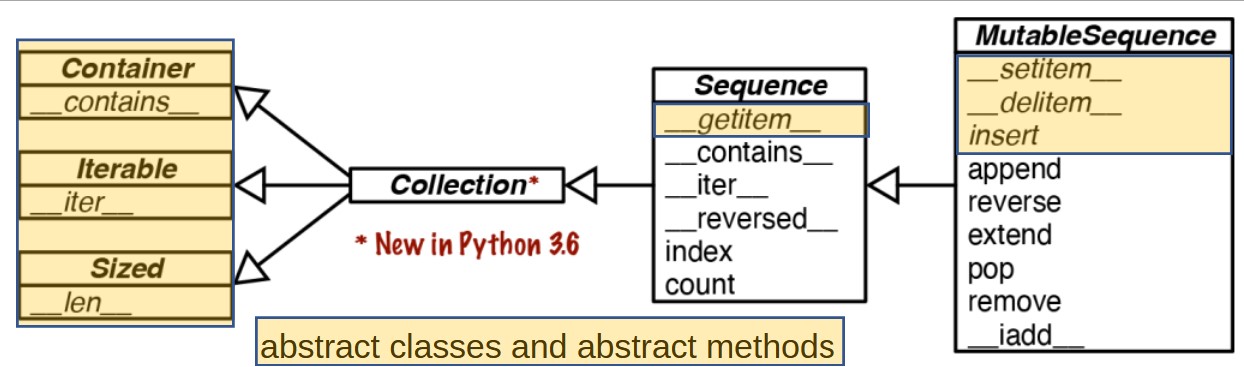
__len__: Returns the number of items in the deck.__getitem__: Retrieves a card at a given position.__setitem__: Allows assigning a card to a specific position, enabling mutability.__delitem__: Deletes a card from a specific position, as required by mutable sequences.insert: Inserts a card at a specified position within the deck.
-
Benefits of Subclassing
MutableSequence: Inherited Methods:- From
SequenceABC:__contains__: Checks if a card is in the deck.__iter__: Allows iteration over the deck.__reversed__: Supports reversed iteration.index: Finds the position of a card.count: Counts occurrences of a card.
- From
MutableSequenceABC:append: Adds a card to the end of the deck.reverse: Reverses the order of cards in the deck.extend: Extends the deck with cards from another iterable.pop: Removes and returns the last card.remove: Removes the first occurrence of a specified card.__iadd__: Supports in-place concatenation using+=.
- From
-
Customization:
- The inherited methods from ABCs are implemented in a generic way that works with any sequence. However, subclassers can override these methods with more efficient versions suited to the specific data structure.
- Example:
__contains__- The default implementation performs a sequential scan, which could be inefficient for large sequences. If the deck is sorted, overriding
__contains__to use binary search (viabisect) can significantly improve performance.
- The default implementation performs a sequential scan, which could be inefficient for large sequences. If the deck is sorted, overriding
ABCs in the Python Standard Library
- Introduction to ABCs:
- Since Python 2.6, the standard library has included several Abstract Base Classes (ABCs) to define interfaces for various types of objects.
- ABCs are primarily located in the
collections.abcmodule, but others can be found in theioandnumberspackages. - ABCs provide a way to enforce type constraints and establish a common interface across different implementations.
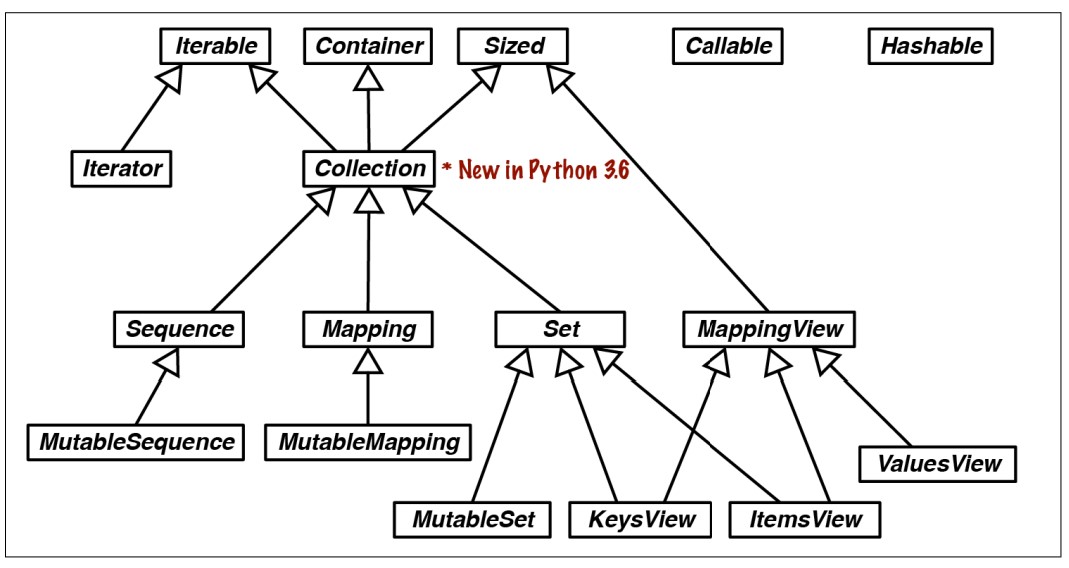
- The goal of understanding and using ABCs is not to create new ones unnecessarily, but to be able to read and understand the ABCs in the standard library and other packages. This understanding helps in writing more robust, maintainable, and Pythonic code by leveraging established interfaces and behaviors.
-
Key Modules:
collections.abc:- Contains most of the widely used ABCs for collections, such as
Iterable,Container, andSized.
- Contains most of the widely used ABCs for collections, such as
abcModule:- This module defines the
ABCclass, from which all ABCs inherit. It is typically used when creating custom ABCs. - Note: The
collections.abcmodule is implemented in_collections_abc.pyand is imported separately from thecollectionspackage for performance reasons.
- This module defines the
-
Overview of Important ABCs:
-
Basic Collection ABCs:
Iterable:- Supports iteration using
__iter__.
- Supports iteration using
Container:- Supports membership testing using
__contains__(used with theinoperator).
- Supports membership testing using
Sized:- Supports size queries using
__len__.
- Supports size queries using
Collection:- Added in Python 3.6, this ABC has no methods of its own but makes it easier to create classes that combine
Iterable,Container, andSized.
- Added in Python 3.6, this ABC has no methods of its own but makes it easier to create classes that combine
-
Immutable Collection Types:
Sequence:- Represents an immutable sequence, such as
tupleorstr.
- Represents an immutable sequence, such as
Mapping:- Represents an immutable mapping, such as
dict.
- Represents an immutable mapping, such as
Set:- Represents an immutable set of unique items.
-
Mutable Collection Types:
- Each immutable collection type has a corresponding mutable subclass:
MutableSequence(e.g.,list)MutableMapping(e.g.,dict)MutableSet(e.g.,set)
- Each immutable collection type has a corresponding mutable subclass:
-
MappingView ABCs:
- These ABCs are used for the objects returned by dictionary methods like
.items(),.keys(), and.values():ItemsViewKeysViewValuesView
ItemsViewandKeysViewalso implement theSetinterface, allowing set operations on dictionary views.
- These ABCs are used for the objects returned by dictionary methods like
-
Other Important ABCs:
Iterator:- Subclass of
Iterable, representing objects that can be iterated over once.
- Subclass of
Callable:- Represents objects that can be called like a function (supports
__call__). - More convenient to check using
callable(obj)thanisinstance(obj, Callable).
- Represents objects that can be called like a function (supports
Hashable:- Represents objects that can be hashed (supports
__hash__). isinstance(obj, Hashable)can be misleading; it's more reliable to usehash(obj)and catch aTypeErrorif the object isn't hashable.
- Represents objects that can be hashed (supports
-
-
Common Pitfalls with ABCs:
-
isinstancewithHashable:- May return
Truefor a tuple that contains unhashable elements, even though the tuple itself is not hashable. - Better Approach: Call
hash(obj)to check hashability.
- May return
-
isinstancewithIterable:- May return
Falseeven if the object is iterable through the__getitem__method using 0-based indices. - Better Approach: Call
iter(obj)to reliably check if an object is iterable.
- May return
-
-
Practical Use of ABCs:
-
Subclassing and Implementing ABCs:
- When creating new collection types or other data structures, it's often beneficial to subclass existing ABCs like
MutableSequence,Mapping, orSet. - This ensures your class implements the expected methods and behaviors.
- When creating new collection types or other data structures, it's often beneficial to subclass existing ABCs like
-
Goose Typing:
- Use
isinstance(obj, SomeABC)checks to enforce type constraints and ensure that objects adhere to the expected interface. - Registration of virtual subclasses allows flexibility in recognizing classes that implement the necessary interface without direct inheritance from the ABC.
- Use
-
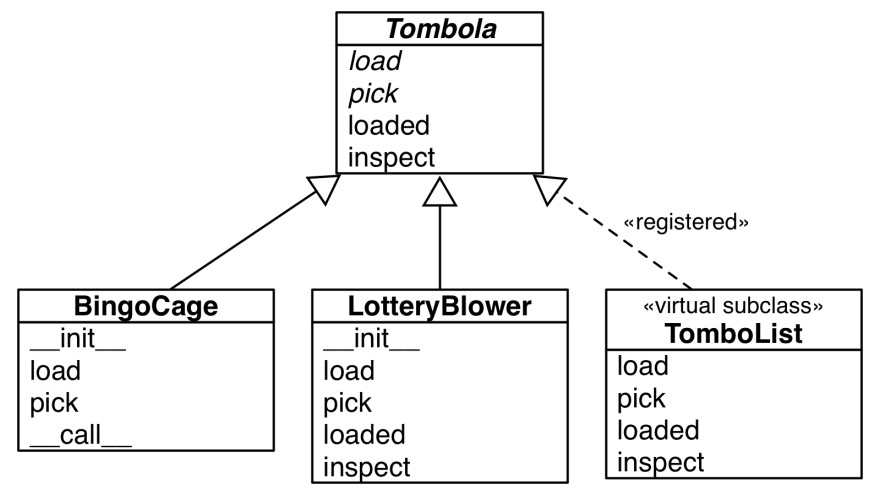
Defining and Using an ABC in Python: The Tombola Example
-
Imagine building an ad management framework called ADAM, where you need to display ads in a random order without repetition until all ads have been shown. To support custom non-repeating random-picking classes, you can define an ABC.
-
The
TombolaABC represents a general-purpose interface for such random-picking containers, akin to bingo cages or lottery blowers. -
Defining the
TombolaABC:import abc class Tombola(abc.ABC): @abc.abstractmethod def load(self, iterable): """Add items from an iterable.""" @abc.abstractmethod def pick(self): """Remove item at random, returning it. This method should raise `LookupError` when the instance is empty. """ def loaded(self): """Return `True` if there's at least 1 item, `False` otherwise.""" return bool(self.inspect()) def inspect(self): """Return a sorted tuple with the items currently inside.""" items = [] while True: try: items.append(self.pick()) except LookupError: break self.load(items) return tuple(sorted(items)) -
Key Features of the
TombolaABC:-
Abstract Methods:
load(self, iterable):- Adds items from an iterable to the container.
- Must be implemented by any subclass.
pick(self):- Removes and returns a random item from the container.
- Should raise
LookupErrorif the container is empty.
-
Concrete Methods:
loaded(self):- Returns
Trueif the container has at least one item; otherwise,False. - Uses the
inspect()method to check if the container is empty.
- Returns
inspect(self):- Returns a sorted tuple of items in the container without modifying the container’s state.
- Uses the
pick()method to temporarily empty the container, and then reloads it to restore its original state.
-
-
Concrete Methods in ABCs:
- Concrete methods in an ABC must rely only on the abstract methods or other concrete methods defined within the same ABC.
- This ensures that any subclass implementing the abstract methods will automatically inherit the correct behavior for the concrete methods.
-
Creating a Subclass of
Tombola:- When subclassing
Tombola, you must implement theloadandpickmethods. Failure to do so will prevent the subclass from being instantiated.
- When subclassing
-
Example of a Defective Subclass:
-
If you try to create a subclass of
Tombolawithout implementing all required abstract methods, Python will raise aTypeError. -
Example:
from tombola import Tombola class Fake(Tombola): def pick(self): return 13 f = Fake() # Raises TypeError: Can't instantiate abstract class Fake with abstract method load -
Explanation:
- The
Fakeclass fails to implement theloadmethod, which is required by theTombolaABC. As a result, Python prevents the instantiation ofFake, ensuring that the contract defined by the ABC is respected.
- The
-
-
Why Use ABCs?:
- Enforcing Interfaces: ABCs ensure that all subclasses adhere to a defined interface, making your code more predictable and easier to maintain.
- Flexibility in Design: By defining methods in an ABC, you allow for flexibility in how those methods are implemented, while still ensuring that they exist.
- Improved Type Checking: ABCs can be used in conjunction with type hints to improve static type checking, providing clearer contracts for function arguments and return types.
-
Side notes: exceptions
BaseException
├── SystemExit
├── KeyboardInterrupt
├── GeneratorExit
└── Exception
    ├── StopIteration
    ├── ArithmeticError
    │   ├── FloatingPointError
    │   ├── OverflowError
    │   └── ZeroDivisionError
    ├── AssertionError
    ├── AttributeError
    ├── BufferError
    ├── EOFError
    ├── ImportError
    ├── LookupError
    │   ├── IndexError
    │   └── KeyError
    ├── MemoryError
    ├── NameError
    │   └── UnboundLocalError
    ├── OSError
    │   ├── BlockingIOError
    │   ├── ChildProcessError
    │   ├── ConnectionError
    │   │   ├── BrokenPipeError
    │   │   ├── ConnectionAbortedError
    │   │   ├── ConnectionRefusedError
    │   │   └── ConnectionResetError
    │   ├── FileExistsError
    │   ├── FileNotFoundError
    │   ├── InterruptedError
    │   ├── IsADirectoryError
    │   ├── NotADirectoryError
    │   ├── PermissionError
    │   ├── ProcessLookupError
    │   └── TimeoutError
    ├── ReferenceError
    ├── RuntimeError
    │   ├── NotImplementedError
    │   └── RecursionError
    ├── SyntaxError
    │   └── IndentationError
    │       └── TabError
    ├── SystemError
    ├── TypeError
    ├── ValueError
    │   └── UnicodeError
    │       ├── UnicodeDecodeError
    │       ├── UnicodeEncodeError
    │       └── UnicodeTranslateError
    ├── Warning
        ├── DeprecationWarning
        ├── PendingDeprecationWarning
        ├── RuntimeWarning
        ├── SyntaxWarning
        ├── UserWarning
        ├── FutureWarning
        ├── ImportWarning
        ├── UnicodeWarning
        └── BytesWarning
ABC Syntax Details and Implementing Concrete Subclasses
-
Subclasses of
abc.ABC:- The standard way to create an ABC in Python is to subclass
abc.ABCor any other existing ABC.
- The standard way to create an ABC in Python is to subclass
-
Abstract Methods:
- Abstract methods are methods that must be implemented by any subclass of the ABC.
- These are defined using the
@abstractmethoddecorator.
import abc class MyABC(abc.ABC): @classmethod @abc.abstractmethod def an_abstract_classmethod(cls, ...): pass- Stacking Decorators:
- When stacking decorators, the
@abstractmethoddecorator should be the innermost one, directly above the method definition.
- When stacking decorators, the
-
Deprecated Decorators:
- Python previously had decorators like
@abstractclassmethod,@abstractstaticmethod, and@abstractproperty. These have been deprecated since Python 3.3, as the same effect can be achieved by stacking@abstractmethodwith@classmethod,@staticmethod, or@property.
- Python previously had decorators like
Subclassing an ABC: Concrete Implementations
Given the Tombola ABC (which represents a non-repeating random picker), here are two concrete subclasses that implement its required methods.
-
BingoCageClass:-
Purpose: This class uses a cryptographic randomizer to shuffle items before selecting them.
import random from tombola import Tombola class BingoCage(Tombola): def __init__(self, items): self._randomizer = random.SystemRandom() self._items = [] self.load(items) def load(self, items): self._items.extend(items) self._randomizer.shuffle(self._items) def pick(self): try: return self._items.pop() except IndexError: raise LookupError('pick from empty BingoCage') def __call__(self): return self.pick() -
Details:
load(self, items): Adds items to the internal list and shuffles them usingSystemRandomfor cryptographic randomness.pick(self): Removes and returns an item from the end of the shuffled list, raising aLookupErrorif the list is empty.__call__(self): Allows theBingoCageinstance to be callable, returning a picked item.
-
-
LottoBlowerClass:-
Purpose: This class picks items by randomly selecting and removing them from a specific position in the list.
import random from tombola import Tombola class LottoBlower(Tombola): def __init__(self, iterable): self._balls = list(iterable) def load(self, iterable): self._balls.extend(iterable) def pick(self): try: position = random.randrange(len(self._balls)) except ValueError: raise LookupError('pick from empty LottoBlower') return self._balls.pop(position) def loaded(self): return bool(self._balls) def inspect(self): return tuple(self._balls) -
Details:
__init__(self, iterable): Initializes the class by converting the iterable into a list.pick(self): Selects and removes an item from a random position in the list. Raises aLookupErrorif the list is empty.loaded(self): Overrides theloadedmethod to directly check if the internal list has items, improving efficiency.inspect(self): Returns a tuple of the items remaining in the list, preserving their current order.
-
Key Points and Best Practices
-
Concrete Methods in ABCs:
- Concrete methods in an ABC can rely only on the abstract methods or other concrete methods within the same ABC. This ensures that subclasses have all the necessary methods to support the inherited concrete methods.
-
Subclassing and Inheritance:
- Concrete subclasses can override inherited methods to provide more efficient implementations, as seen with
loaded()andinspect()inLottoBlower.
- Concrete subclasses can override inherited methods to provide more efficient implementations, as seen with
-
Practical Use of ABCs:
- The use of ABCs, combined with concrete implementations like
BingoCageandLottoBlower, ensures that different subclasses adhere to a consistent interface while allowing flexibility in how they fulfill the requirements of that interface.
- The use of ABCs, combined with concrete implementations like
Virtual Subclassing an ABC in Python
-
Virtual Subclasses Overview:
- Goose Typing: In Python, "goose typing" refers to the ability to register a class as a virtual subclass of an Abstract Base Class (ABC) without actually inheriting from it. This allows the class to be recognized as a subclass by
issubclassandisinstancechecks, even though it doesn’t inherit any methods or attributes from the ABC. - Registration: You can register a class as a virtual subclass using the
registermethod on the ABC. This method can be called directly or used as a decorator. - While virtual subclassing is powerful, it should be used judiciously. Ensure that the registered class fully implements the ABC’s interface to avoid runtime errors.
- Goose Typing: In Python, "goose typing" refers to the ability to register a class as a virtual subclass of an Abstract Base Class (ABC) without actually inheriting from it. This allows the class to be recognized as a subclass by
-
Key Characteristics:
- No Inheritance: Virtual subclasses do not inherit from the ABC they are registered with. They are not checked for conformance to the ABC’s interface at the time of registration or instantiation.
- Runtime Exceptions: If the virtual subclass does not actually implement the required interface, errors will be caught during runtime when the relevant methods are called.
- Static Type Checkers: Current static type checkers, such as MyPy, do not support virtual subclasses.
from random import randrange from tombola import Tombola @Tombola.register class TomboList(list): def pick(self): if self: position = randrange(len(self)) return self.pop(position) else: raise LookupError('pop from empty TomboList') load = list.extend def loaded(self): return bool(self) def inspect(self): return tuple(self)- Decorator Registration:
@Tombola.registerregistersTomboListas a virtual subclass ofTombola.- This means
TomboListwill passissubclass(TomboList, Tombola)andisinstance(t, Tombola)checks, wheretis an instance ofTomboList.
- Inheriting from
list:TomboListdirectly subclasseslistand leverages its built-in methods.
pick(self)Method:- Implements the
pickmethod required byTombola. It removes a random item from the list.
- Implements the
load(self, iterable)Method:- Uses
list.extendto implement theloadmethod by directly extending the list with new items.
- Uses
loaded(self)andinspect(self):- These methods check whether the list is non-empty and return its contents, respectively.
-
Checking the Virtual Subclass:
-
After registering
TomboListas a virtual subclass, it behaves as if it were a subclass ofTombola:from tombola import Tombola from tombolist import TomboList print(issubclass(TomboList, Tombola)) # Output: True t = TomboList(range(100)) print(isinstance(t, Tombola)) # Output: True
-
-
Understanding Method Resolution Order (MRO):
-
MRO: The Method Resolution Order (
__mro__) of a class shows the hierarchy Python uses to search for methods. -
In the case of
TomboList,Tomboladoes not appear in its__mro__, confirming thatTomboListdoes not inherit any methods fromTombola:print(TomboList.__mro__) # Output: (<class 'tombolist.TomboList'>, <class 'list'>, <class 'object'>)
-
-
Usage of
registerin Practice:- Direct Registration:
-
The
registermethod is often used to register built-in or external classes as virtual subclasses of ABCs. -
Example:
from collections.abc import Sequence Sequence.register(tuple) Sequence.register(str) Sequence.register(range) Sequence.register(memoryview) -
These registrations occur in the
_collections_abc.pymodule and are activated when the module is imported.
-
- Direct Registration:
Structural Typing with ABCs
-
Nominal vs. Structural Typing:
- Nominal Typing: Involves explicitly linking a class to an ABC through inheritance or registration. For example, a class
Subcan inherit fromAnABC, or it can be registered as a virtual subclass usingAnABC.register(Sub). - Structural Typing: Determines the type of an object based on its structure, specifically the methods and attributes it implements, rather than its explicit inheritance hierarchy.
- Nominal Typing: Involves explicitly linking a class to an ABC through inheritance or registration. For example, a class
-
Structural Typing in ABCs:
-
Some Abstract Base Classes (ABCs) in Python support structural typing, allowing a class to be recognized as a subclass of an ABC if it implements certain methods, even if it doesn’t explicitly inherit from or register with that ABC.
-
Example:
- The
abc.SizedABC considers any class that implements the__len__method to be a virtual subclass, even if the class doesn’t inherit fromSizedor register with it.
class Struggle: def __len__(self): return 23Struggleimplements__len__, which is sufficient for it to be considered a subclass ofabc.Sized.
from collections import abc print(isinstance(Struggle(), abc.Sized)) # Output: True print(issubclass(Struggle, abc.Sized)) # Output: True- Both
isinstanceandissubclassreturnTruebecauseabc.Sizedchecks for the presence of the__len__method using the__subclasshook__mechanism.
- The
-
-
How
__subclasshook__Works:-
Definition of
abc.Sized:- The
__subclasshook__method is defined inSizedto check if a class or any of its superclasses implements__len__.
class Sized(metaclass=ABCMeta): __slots__ = () @abstractmethod def __len__(self): return 0 @classmethod def __subclasshook__(cls, C): if cls is Sized: if any("__len__" in B.__dict__ for B in C.__mro__): return True return NotImplemented- The
__subclasshook__method checks if__len__is present in the__dict__of any class in the method resolution order (__mro__) of the class being checked. - If
__len__is found, the method returnsTrue, indicating that the class is a virtual subclass ofSized.
- The
-
-
When to Use
__subclasshook__:- Caution with Custom ABCs:
- Implementing
__subclasshook__in your own ABCs can be risky because it assumes that any class with a specific method will behave as expected. - Example: A class might implement
__len__,__getitem__, and__iter__, but that doesn’t necessarily mean it should be considered aSequence. Thus,abc.Sequencedoes not implement__subclasshook__.
- Implementing
- Caution with Custom ABCs:
Static Protocols
-
Static protocols in Python, introduced in PEP 544, allow for structural typing (static duck typing) within Python’s type hinting system.
-
This enables you to specify that a function parameter must support a particular set of operations, rather than needing it to be of a specific type or subclass.
-
The
doubleFunction Example:-
Dynamic Nature:
- The
doublefunction demonstrates Python’s dynamic typing by working with various types (e.g.,int,str,list,Fraction, custom objects) as long as the type supports multiplication (*).
def double(x): return x * 2 print(double(1.5)) # Output: 3.0 print(double('A')) # Output: 'AA' print(double([10, 20, 30])) # Output: [10, 20, 30, 10, 20, 30] - The
-
-
Challenges with Type Hints Before Static Protocols:
- Before the introduction of static protocols, it was difficult to add type hints to such flexible functions without limiting their use to specific types.
- This limitation arose because the type hint system initially relied on nominal typing, where types needed to be explicitly named.
-
Introducing
typing.Protocol:- Purpose:
typing.Protocolallows the creation of structural types, meaning you can define a type based on the presence of certain methods or attributes rather than its inheritance hierarchy.
from typing import TypeVar, Protocol T = TypeVar('T') class Repeatable(Protocol): def __mul__(self: T, repeat_count: int) -> T: ... RT = TypeVar('RT', bound=Repeatable) def double(x: RT) -> RT: return x * 2RepeatableProtocol:- This protocol defines a contract that any type implementing it must support multiplication (
__mul__) with anintand return an instance of the same type.
- This protocol defines a contract that any type implementing it must support multiplication (
- Type Variables:
T: Used to ensure that the return type of__mul__matches the type ofself.RT: A type variable bound by theRepeatableprotocol, meaningRTmust be a type that implementsRepeatable.
- Function
double(x: RT) -> RT:- The type hint now tells the type checker that
xmust be of a type that implements theRepeatableprotocol, ensuring it can be multiplied by2and return a result of the same type.
- The type hint now tells the type checker that
- Purpose:
-
Advantages of Static Protocols:
- Enhanced Flexibility: You can type-check functions like
doublewithout restricting them to specific types, as long as the type implements the required operations. - Future-Proofing: The function remains compatible with new types that implement the necessary operations, such as custom types introduced later in the codebase or by third-party libraries.
- Static Duck Typing: Combines the dynamic flexibility of duck typing with the static safety of type checking, making it easier to write Pythonic code that is also type-safe.
- Enhanced Flexibility: You can type-check functions like
-
Usage Example with Custom Types:
-
Consider a
Vectorclass that supports multiplication:from vector_v7 import Vector v = Vector([11.0, 12.0, 13.0]) print(double(v)) # Output: Vector([22.0, 24.0, 26.0]) -
The
doublefunction can work seamlessly withVectorinstances because they conform to theRepeatableprotocol.
-
Runtime Checkable Static Protocols in Python
-
While static protocols are primarily used for type checking during static analysis, they can be made runtime checkable by using the
@runtime_checkabledecorator. This allows them to be used withisinstanceandissubclasschecks at runtime.- The
SupportsComplexprotocol defines an interface for types that can be converted to acomplexnumber. It requires the implementation of the__complex__method.
from typing import Protocol, runtime_checkable @runtime_checkable class SupportsComplex(Protocol): """An ABC with one abstract method __complex__.""" def __complex__(self) -> complex: pass - The
-
Runtime Example:
- You can use
SupportsComplexto check if a type implements the__complex__method, even if it does not inherit fromSupportsComplexor a similar class.
from typing import SupportsComplex import numpy as np c64 = np.complex64(3+4j) print(isinstance(c64, SupportsComplex)) # Output: True c = complex(c64) print(c) # Output: (3+4j)- NumPy’s
complex64type is not a subclass of Python's built-incomplex, but it implements the__complex__method. This makes it compatible with theSupportsComplexprotocol, allowing it to be checked at runtime withisinstanceand used as an argument to thecomplex()function.
- You can use
-
Practical Use Case for
SupportsComplex: Checking Compatibilityfrom typing import SupportsComplex from numbers import Complex def use_as_complex(o: SupportsComplex) -> complex: if isinstance(o, SupportsComplex): return complex(o) raise TypeError('o must be convertible to complex') # This works because complex64 is a SupportsComplex c64 = np.complex64(3+4j) print(use_as_complex(c64)) # Output: (3+4j)
Duck Typing vs. Explicit Type Checking
-
Duck Typing:
- Instead of using
isinstancechecks, you can rely on Python's dynamic nature and attempt the operation directly, handling any exceptions that arise. This is known as the EAFP (Easier to Ask for Forgiveness than Permission) principle.
def use_as_complex(o): try: return complex(o) except TypeError as exc: raise TypeError('o must be convertible to complex') from exc # If o is not compatible, Python raises an appropriate exception. c = use_as_complex(np.complex64(3+4j)) - Instead of using
-
Comparison:
- Explicit Checking:
- Useful when you need to ensure an object meets certain interface requirements before performing operations on it. This can be particularly helpful in large codebases or when using external type checkers like Mypy.
- Duck Typing:
- Often more flexible and Pythonic, as it leverages the language’s dynamic typing capabilities. It can reduce boilerplate code and avoid unnecessary checks.
- Explicit Checking:
When to Use Runtime Checkable Protocols
-
Good Use Cases:
- When you need to combine static type checking with runtime validation, particularly in codebases where both dynamic and static typing practices are used.
- Useful in APIs where you want to ensure that objects passed to functions meet specific interface requirements, but without enforcing a strict inheritance hierarchy.
-
Limitations:
- While runtime checkable protocols offer flexibility, they can introduce overhead if used excessively for runtime checks. Duck typing might be a better choice in performance-critical code.
- Static type checkers like Mypy cannot always recognize virtual subclasses or runtime-registered protocols, limiting the effectiveness of runtime checkable protocols in some static analysis scenarios.
Limitations of Runtime Protocol Checks in Python
-
Python’s type hints are primarily used for static type checking and are generally ignored at runtime. This limitation also extends to runtime checks using
isinstanceorissubclasswhen dealing with static protocols defined usingtyping.Protocol. -
SupportsFloat Protocol:
- The
SupportsFloatprotocol checks if a class has a__float__method. However, this check only verifies the existence of the method, not its behavior or return type.
- The
-
Complex Type Example:
-
In Python 3.9, the
complextype has a__float__method, but this method is designed to raise aTypeErrorbecause acomplexnumber cannot be converted to afloat. -
Console Session:
import sys
print(sys.version)  # Output: '3.9.5 (v3.9.5:0a7dcbdb13, May 3 2021, 13:17:02)'

c = 3+4j
print(c.__float__)  # Output: <method-wrapper '__float__' of complex object>
print(c.__float__())  # Raises TypeError: can't convert complex to float
-
-
Misleading
isinstanceandissubclassChecks:-
Despite the
__float__method being present, checking ifcomplexis a subclass ofSupportsFloator if an instance ofcomplexis an instance ofSupportsFloatwill incorrectly returnTrue. -
Example:
from typing import SupportsFloat

c = 3+4j
print(isinstance(c, SupportsFloat))  # Output: True
print(issubclass(complex, SupportsFloat))  # Output: True
-
Limitations and Consequences
-
Method Presence vs. Method Behavior:
isinstanceandissubclasschecks against protocols likeSupportsFloatonly confirm the presence of the required method (__float__in this case). They do not verify:- The method's signature.
- The method's return type.
- Whether the method functions correctly according to the protocol’s intent.
-
Impact of Ignoring Type Hints at Runtime:
- Even if the
__float__method had proper type annotations (e.g., returningNoReturnto indicate it always raises an exception), Python’s runtime checks would not consider these annotations, leading to misleading results.
- Even if the
-
Performance Considerations:
- Implementing comprehensive type checks at runtime would significantly degrade performance, which is why Python avoids verifying method signatures or annotations during
isinstanceorissubclasschecks.
- Implementing comprehensive type checks at runtime would significantly degrade performance, which is why Python avoids verifying method signatures or annotations during
Resolution and Workarounds
-
Python 3.10 Fix:
- The specific issue with the
complextype’s__float__method was resolved in Python 3.10 by removing the method entirely. This preventscomplexfrom incorrectly being recognized as aSupportsFloatinstance or subclass.
- The specific issue with the
-
General Advice:
- Awareness of Limitations:
- Be aware of the limitations of runtime checks against protocols. These checks are useful but not foolproof, as they can lead to incorrect assumptions about an object’s capabilities.
- Duck Typing:
- Instead of relying solely on
isinstanceorissubclasschecks, consider using duck typing with the EAFP (Easier to Ask for Forgiveness than Permission) principle. Attempt the operation directly and handle exceptions if they occur.
- Instead of relying solely on
- Awareness of Limitations:
-
Example of Duck Typing:
def convert_to_float(o):
    try:
        return float(o)
    except (TypeError, ValueError) as exc:
        raise TypeError("Object cannot be converted to float") from exc

c = 3+4j
try:
    print(convert_to_float(c))  # Will raise TypeError and provide a clear message
except TypeError as e:
    print(e)
Designing a Static Protocol in Python: The RandomPicker Example
Context
- Protocols in Python: Protocols in Python allow you to define interfaces that classes can conform to without explicitly inheriting from them. This is particularly useful for static type checking and enhances the flexibility of duck typing.
- Single-Method Protocols: Inspired by the Go programming language, single-method protocols are often more useful and flexible. You can later combine them into more complex protocols if needed.
Defining the RandomPicker Protocol
-
Purpose: The
RandomPickerprotocol defines a minimal interface that requires implementing a single method,pick, which returns an item. -
Example 13-18: Defining
RandomPicker:from typing import Protocol, runtime_checkable, Any @runtime_checkable class RandomPicker(Protocol): def pick(self) -> Any: ...- Key Points:
@runtime_checkable: This decorator allowsRandomPickerto be used withisinstanceandissubclasschecks at runtime.pick(self) -> Any: Thepickmethod is expected to return an item, and its return type is currently set toAny. This makes the protocol flexible and applicable to various implementations.
- Key Points:
Using the RandomPicker Protocol
-
Implementing the Protocol:
- The
SimplePickerclass implements theRandomPickerprotocol by providing apickmethod that pops a shuffled item from a list.
import random from typing import Any, Iterable, TYPE_CHECKING from randompick import RandomPicker class SimplePicker: def __init__(self, items: Iterable) -> None: self._items = list(items) random.shuffle(self._items) def pick(self) -> Any: return self._items.pop() def test_isinstance() -> None: popper: RandomPicker = SimplePicker([1]) assert isinstance(popper, RandomPicker) def test_item_type() -> None: items = [1, 2] popper = SimplePicker(items) item = popper.pick() assert item in items if TYPE_CHECKING: reveal_type(item) assert isinstance(item, int)- Implementing
RandomPicker:SimplePickerimplements theRandomPickerprotocol without explicitly subclassing it. This is a key feature of static duck typing in Python.
- Runtime Check with
isinstance:- The
test_isinstancefunction demonstrates that you can useisinstanceto check if an instance conforms to theRandomPickerprotocol, thanks to the@runtime_checkabledecorator.
- The
- Type Checking with
reveal_type:- Inside
test_item_type, thereveal_type(item)function, recognized by Mypy, helps reveal the type ofitemat runtime. This function is only invoked during static type checking and is skipped during actual execution.
- Inside
- The
Results of Running Mypy
- Expected Output:
-
Running Mypy on the test code will reveal that Mypy understands
SimplePickeras consistent with theRandomPickerprotocol. -
Output Example:
$ mypy randompick_test.py randompick_test.py:24: note: Revealed type is 'Any' -
The output shows that the type of
itemisAnybased on thepickmethod's return type, as expected.
-
Conclusion
- Advantages of Single-Method Protocols:
- Single-method protocols, like
RandomPicker, make static duck typing more flexible. They allow you to define minimal interfaces that can be combined into more complex protocols as needed.
- Single-method protocols, like
- Runtime and Static Type Checking:
- The combination of runtime checkability with static type checking allows you to write flexible yet type-safe code. Using
@runtime_checkable, you can ensure your protocols work withisinstanceandissubclasschecks while benefiting from static type checking with tools like Mypy.
- The combination of runtime checkability with static type checking allows you to write flexible yet type-safe code. Using
- Mypy Integration:
- The integration with Mypy provides additional safety by ensuring that your classes correctly implement the required methods and adhere to the expected interfaces, catching potential errors early in the development process.
Best Practices for Protocol Design in Python
- Designing effective protocols in Python, particularly for static typing, requires careful consideration to ensure flexibility, maintainability, and adherence to key software design principles.
- Below are some best practices inspired by the experience of other programming communities, particularly Go, and established design principles.
1. Favor Narrow Protocols
- Definition: A narrow protocol defines a minimal interface, often with just one or two methods. This makes the protocol easy to implement and understand.
- Benefits:
- Flexibility: Narrow protocols are more adaptable to different use cases. They allow classes to implement only what is necessary without being burdened by a large, monolithic interface.
- Extendability: If additional functionality is needed later, you can easily extend a narrow protocol by combining it with other protocols or creating a new derived protocol.
- Example:
- Instead of defining a protocol with multiple methods, create single-method protocols like
Reader,Writer, orCloser, which can be combined as needed.
- Instead of defining a protocol with multiple methods, create single-method protocols like
2. Design Protocols with the "Role Interface" Concept
- Role Interface:
- A concept where interfaces (or protocols) are designed to represent a specific role an object might play. This is particularly useful in systems where an object might serve multiple roles.
- Example:
- A
Readerprotocol for objects that can read data, and aWriterprotocol for objects that can write data. An object could implement both if it plays both roles.
- A
3. Define Protocols Close to Client Code
- Client-Code Protocols:
- Sometimes it’s beneficial to define a protocol directly within or near the function or module that uses it, rather than in a general-purpose library.
- Advantages:
- Ease of Extensibility: Makes it easier to create new types specifically for that function or module.
- Testing: Facilitates testing with mocks, as the protocol is defined in the same context where it is used.
- Example:
- Define a protocol within a module that handles file I/O, rather than in a separate utilities module. This keeps the protocol tightly coupled to its usage context while remaining flexible.
4. Adhere to the Interface Segregation Principle (ISP)
- ISP Summary: "Clients should not be forced to depend upon interfaces that they do not use."
- Application in Protocol Design:
- Avoid creating large protocols that require implementing methods unnecessary for certain clients. Instead, break down large interfaces into smaller, more specific protocols.
- Example:
- Instead of a monolithic
FileHandlerprotocol that includes reading, writing, closing, and seeking methods, create separate protocols likeReader,Writer, andSeeker.
- Instead of a monolithic
- Application in Protocol Design:
5. Naming Conventions
- Use Clear, Descriptive Names:
- Plain Names: For protocols that represent a clear concept (e.g.,
Iterator,Container). - SupportsX: For protocols that provide callable methods (e.g.,
SupportsInt,SupportsRead). - HasX: For protocols that involve readable/writable attributes or getter/setter methods (e.g.,
HasItems,HasFileno).
- Plain Names: For protocols that represent a clear concept (e.g.,
- Go-Inspired Naming:
- For single-method protocols, use a noun form of the verb by appending “-er” or “-or” (e.g.,
Reader,Writer,Formatter). This aligns with the convention used in the Go language and makes the purpose of the protocol immediately clear. - Example:
- Instead of
SupportsRead, useReader. - Instead of
SupportsWrite, useWriter.
- Instead of
- For single-method protocols, use a noun form of the verb by appending “-er” or “-or” (e.g.,
6. Extendability through Derived Protocols
- Extendability:
- Start with a minimal protocol and extend it by creating derived protocols when more functionality is required.
- Example:
- Begin with a
Readerprotocol. If later you need a type that also resets its position, you can create anAdvancedReaderprotocol that extendsReaderand adds areset()method.
- Begin with a
7. Example of Protocol Evolution
-
Initial Protocol:
from typing import Protocol class Reader(Protocol): def read(self) -> str: ... -
Extended Protocol:
class AdvancedReader(Reader, Protocol):
    def reset(self) -> None:
        ...
The Numbers ABCs and Numeric Protocols: A Summary
- Python's numeric Abstract Base Classes (ABCs) in the
numbersmodule work well for runtime type checking, but they present limitations when it comes to static type checking. The introduction of numeric protocols in thetypingmodule offers a partial solution, but these protocols also have their own limitations, particularly when dealing with complex numbers.
1. Numbers ABCs for Runtime Type Checking
-
Purpose: The
numbersmodule provides ABCs that help identify and work with different numeric types at runtime. These include:numbers.Number: The base class for all numeric types.numbers.Integral: For integer types (int,bool, and others).numbers.Real: For floating-point types.numbers.Complex: For complex number types.
-
Usage:
-
You can use these ABCs with
isinstanceandissubclassto perform runtime checks. -
Example:
import numbers

x = 42
print(isinstance(x, numbers.Integral))  # True
-
-
Limitations:
- The
numbers.NumberABC has no methods, making it unsuitable for static type checking. If you declare a variable asx: Number, tools like Mypy will not allow you to perform arithmetic or call any methods onx. - Certain numeric types, like
decimal.Decimal, are intentionally not registered as subclasses ofnumbers.Realto prevent accidental mixing with less precise floating-point numbers.
- The
2. Numeric Protocols in the typing Module
-
Purpose: Numeric protocols like
SupportsFloat,SupportsComplex, andSupportsIntwere introduced to improve static type checking by specifying that an object supports specific numeric operations.from typing import SupportsFloat def to_float(value: SupportsFloat) -> float: return float(value) -
Limitations:
- Runtime Issues: These protocols can sometimes provide misleading results at runtime. For example, in Python 3.9, the
complextype has a__float__method that raisesTypeError, butisinstance(x, SupportsFloat)returnsTruefor acomplexnumber. - Static vs. Runtime Discrepancies: While tools like Mypy can correctly identify types that support these protocols during static analysis, the runtime behavior may not align due to the way Python handles certain types, especially with complex numbers.
- Runtime Issues: These protocols can sometimes provide misleading results at runtime. For example, in Python 3.9, the
3. Static Type Checking Challenges
-
Static Type Checking Limitations:
- The
numbersABCs do not work well for static type checking because they do not define any operations that static type checkers can verify. - Typeshed and Numeric Protocols: The Python
typeshedproject defines type hints like_Number(a union offloat,Decimal, andFraction) for use in the standard library. However, this approach doesn't account for numeric types from external libraries, which thenumbersABCs support at runtime.
- The
-
Mypy Behavior:
- Mypy, a popular static type checker, pragmatically recognizes that
intandfloatcan be converted tocomplex, even though they do not implement__complex__. This behavior helps bridge the gap between static type checking and Python's dynamic runtime behavior.
- Mypy, a popular static type checker, pragmatically recognizes that